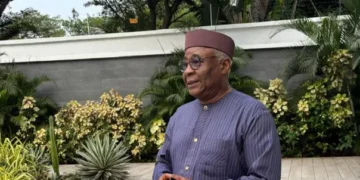


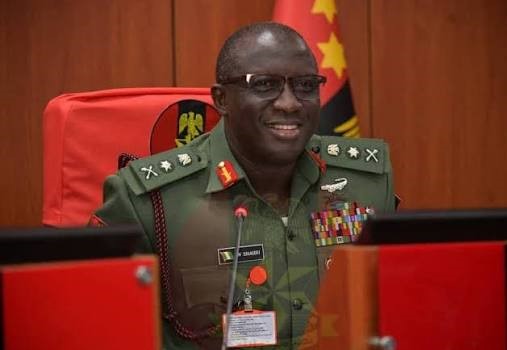
A former military intelligence officer, Colonel Frank Omenka(rtd) whose name featured prominently in allegations of abuses during Nigeria’s military era, is set to publicly discuss his role in the late General Sanni Abacha years of military dictatorship with the theme “The Abacha Years: Obeying the last order and the untold accounts.”
Penpushing reports that Omenka is scheduled to feature on virtual panel discussion slated for June 25,2026 for the first time in more than three decades and has remained one of the most talked-about yet least-heard figures of Nigeria’s military era.
The retired colonel, a central figure during the controversial era, throughout the years of accusations, testimony and public scrutiny, has remained largely silent, however, from all indications now, that silence is now coming to an end
Penpushing further reports that, what is widely documented about Omenka, was his rise within the Directorate of Military Intelligence (DMI), one of the most influential institutions in the country’s security architecture in the 1990s.
The Directorate of Military Intelligence (DMI) served as the Nigerian Army’s intelligence arm, responsible for military intelligence gathering, counter-intelligence operations and internal security reporting.
Penpushing also reports that during the dark days of Abacha era, critics of the government accused military intelligence and other security agencies of playing central roles in monitoring opponents, suppressing dissent and investigating perceived threats to the regime.
The former detainees, journalists and human rights activists frequently identified Omenka as one of the most influential officers within that structure, while his name became particularly associated with the Directorate of Military Intelligence (DMI) Security Group, which numerous former detainees linked to detention and interrogation operations during the period.
Penpushing reports that it will be recalled that Human rights petitioners referenced Omenka during proceedings of the Oputa Panel, the landmark inquiry established after Nigeria’s return to democratic rule in 1999, while his public reputation was formed through the accounts of others
The record has it that following the end of military rule, former political detainees, journalists, students, labour activists and military officers accused of involvement in alleged coup plots appeared before the Human Rights Violations Investigation Commission, popularly known as Oputa Panel, with many describing experiences of detention, interrogation and alleged mistreatment while in military custody, however, several witnesses specifically mentioned Omenka.
Penpushing further reports that Human rights organisations equally documented allegations of arbitrary detention, torture and abuse involving security agencies during the period, while some former detainees alleged that interrogations conducted by military intelligence officers involved intimidation, coercion and physical abuse, and journalists who reported critically on the government similarly recounted encounters with security officials.
The virtual panel discussion will revisit the inner workings of the Abacha government, allegations that have followed Omenka since the 1990s, and the lessons he believes the period holds for contemporary security challenges in Nigeria and West Africa.
Penpushing also reports that at a 2000 sitting of the Oputa panel, witnesses alleged that Omenka raped and impregnated an 18-year-old detainee identified as Bunmi Samuel, said to have later died following complications after her release, according to an archived report of the proceedings.
The Experiential Leadership in Africa (TEL-Africa), in partnership with Premium Times is to host the first extensive public conversation with the retired colonel and former commander of the Directorate of Military Intelligence (DMI) Security Group since the end of military rule.
Penpushing reports that the panelists include Premium Times’ Publisher, Dapo Olorunyomi, Idris Akinbajo (Managing Editor Premium Times), Kunle Ajibade (Editor The News Magazine); and Adeolu Adewumi, a catalyst at TEL Africa
Meanwhile, Abacha years remain among the most contested periods in Nigeria’s post-independence history, with debates over accountability, security, governance and human rights from that era continue to shape national conversations today, and for decades, those debates have included Omenka, but largely without his voice.
FOOTNOTE: You want to share story with us? You want to advertise with us? You need publicity for product, or service, or event? Contact us on WhatsApp +2348073463653 or email penpushing@yahoo.com