
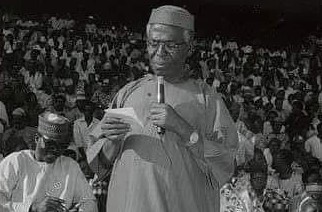
I join our host, Ambassador Dr Tokunbo Awolowo, in welcoming you all to this lecture in honour and remembrance of the Sage Chief Obafemi Awolowo GCFR on this day the 117th anniversary of his birth, and in this town of his birth, Ikenne, which has as a result become emblazoned on the map of Nigeria.
It is right to recall that Chief Obafemi Awolowo was one of the three founding fathers of modern Nigeria, and that his exemplary legacies in service as the Premier of the Western Region, as the Leader of Opposition in Nigeria’s independence Parliament, and as the Vice Chairman and Commissioner of Finance in the Supreme Military Council that governed the country during the early years of its major national crisis, clearly validated the saying that Chief Obafemi Awolowo was the best President that Nigeria never had.
It was for this reason that the Obafemi Awolowo Foundation established fourteen years ago in his name a leadership award for outstanding individuals who in their career have demonstrated the attributes of the Sage. The attributes include personal discipline, cerebral leadership, integrity, competence, pro-people policies, and genuine patriotism.
I have the honour and privilege of chairing the Selection Committee which, with the assistance of a Technical Committee comprising mainly of university professors, selects the winners of the award.
I am glad that our lecturer of today is the distinguished academic and prolific author, Professor Wale Adebanwi. You will hear more about him from his citation. Suffice it for me at this point to say that after his education in the Universities of Lagos, Ibadan and Cambridge, Professor Adebanwi, among his other academic achievements, became the first Black Rhodes Professor at St Antony’s College Oxford University; and he is presently a Presidential Penn Compact Professor of African Studies at the University of Pennsylvania.
If I may digress a bit here with an anecdote about my personal experience at the University of Pennsylvania. Sixty years ago, on 15th January 1966, I was invited to the University to address the Society for International Affairs along with my counterpart at the British Permanent Mission to the United Nations in New York. I was then serving as First Secretary/Counsellor under the late Ambassador Chief Simeon Adebo at the Nigerian Permanent Mission to the United Nations.
The format of the meeting was that after our speeches on the Unilateral Declaration of Independence (UDI) on 11 November 1965 by Ian Smith, the leader of the racist minority government in the then Rhodesia (now Zimbabwe), the members of the audience were free to put questions to my British colleague and myself.
The first question was put to me by a man who wanted me to tell him a bit more about the military coup d’etat in Nigeria.
I thanked him for his interest in my country but suggested to him that he might be mistaking Nigeria for Algeria where there had been the overthrow of President Ben Bella, or for the Republic of Niger where there was some trouble under President Hamani Diori. But he persisted by saying that on his way to the meeting he heard on his car radio that a military coup had occurred in Nigeria and that the Prime Minister, Sir Abooboo (he could obviously not say the name of our Prime Minister Sir Abubakar Tafawa Balewa) was missing. Whereupon I requested a ten minute break to go to the nearest telephone booth to call my Ambassador in New York. (These were days before the use of mobile phones).
I returned to the hall to tell the audience that it was true that something unusual had happened in my country but that I could not tell the details. This was where and how I learned of the first military coup in Nigeria.
Going back to our lecture, I would like to make a brief comment on only two of the major current challenges facing our country namely, the preoccupation with the 2027 national elections, and the unrelenting insecurity in the country with the continuing kidnappings, abductions and killings in States like Zamfara, Kwara, Niger, Plateau, Benue and Sokoto.
On the 2027 national elections, I want to say to the Government, and in particular to INEC especially after the controversy over electronic transmission of votes from the polling units to INEC Results Viewing Portals (IREV), that the international community will be closely watching the political party campaigns, the processes and the actual conduct of the elections. And that the results of the elections will be assessed for their fairness and credibility by other countries, including in particular those that have diplomatic representation in Nigeria.
Regarding the raging insecurity in several States of the country, I want to say that after over a decade of inability to arrest the kidnappings, the abductions, the killings and the growing populations of people forcefully displaced from their ancestral lands and farms, the Federal Government is right to seek collaboration with friendly countries in addressing the country’s internal insecurity. The only caveat should continue to be that in seeking to effectuate the elimination of the bandits and the jihadists, the collaborative arrangements should remain mindful of the need to respect the sovereignty of Nigeria.
I must now end what should be brief Chairman’s remarks so as to make way for the main business of today namely, the lecture by our honoured guest lecturer, Professor Wale Adebanwi.
Chief Emeka Anyaoku GCON GCVO CFR
Commonwealth Secretary-General 1990-2000
Ikenne, 6 March 2026.
FOOTNOTE: You want to share story with us? You want to advertise with us? You need publicity for product, or service, or event? Contact us on WhatsApp +2348073463653 or email penpushing@yahoo.com