








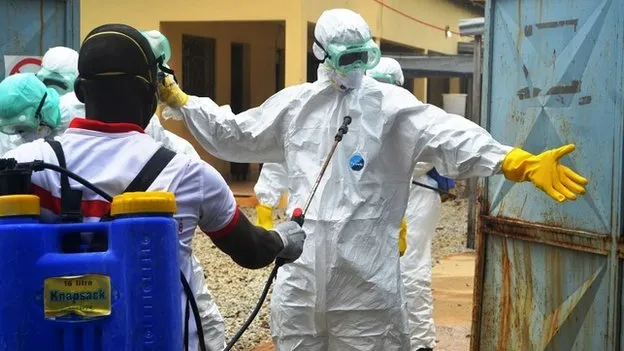
The Nigeria Centre for Disease Control and Prevention (NCDC) has identified 53 contacts linked to Nigeria’s confirmed case of Ebola disease in Anuja, the Federal Capital Territory (FCT).
Penpushing reports that Director-General of Nigeria Centre for Disease Control and Prevention (NCDC), Jide Idris, disclosed this at a media briefing on Sunday in Abuja, where he provided an update on the country’s response to the outbreak.
The Director General explained that the contacts include healthcare workers, the confirmed patient’s domestic staff and spouse, as well as health personnel involved in collecting samples from the patient.
“As of now, we have 53 primary contacts. These comprise 44 people from the health facility where the patient was treated and nine additional contacts. Of the nine additional contacts, three are household members of the patient, her driver, chef and husband’, he said.
‘Three others attended to her at Julius Berger Clinic before she got to the other facility, while the remaining three are members of the team who went to collect samples’, the Director General added
Penpushing further reports that Idris said the contacts had been listed and categorised according to their level of exposure, with public health teams continuing to monitor them, adding that none of the identified contacts had tested positive for Ebola or developed symptoms as of the time of the briefing.
The Director General equally clarified that the agency had investigated two cases, including the confirmed case in the Federal Capital Territory (FCT) and a suspected case in Rivers State, which tested negative for Ebola.
Penpushing also reports that he disclosed that the confirmed patient had returned positive results from three samples collected for testing, while her husband tested negative for the disease.
The Director General said contact tracing was ongoing, with public health teams working to identify people who may have been exposed to the confirmed patient and assess their level of risk.
Penpushing reports that he said identified contacts would be monitored for 21 days after their last possible exposure, in line with Ebola’s incubation period, explaining that the number of contacts could change as investigations progressed and more information became available.
The Director General said that being identified as a contact does not mean a person has Ebola, but allows health authorities to monitor their health and detect possible infections early, however, urged Nigerians contacted by public health officials to cooperate with monitoring teams and provide accurate information about their movements, contacts and any symptoms they might experience.
Penpushing further reports that he said the agency is strengthening laboratory capacity and infection prevention measures across the country as part of efforts to prevent further transmission of the disease.
The Director General said about 12 laboratories had been identified as having the capacity to test for Ebola, while efforts were ongoing to ensure the availability of reagents and other essential supplies.
Penpushing also reports that he said testing for the confirmed case was being conducted at the National Reference Laboratory, with other facilities being supported to ensure suspected cases could be investigated promptly.
The centre boss added that the agency is equally working with health authorities to train healthcare workers on infection prevention and control measures, including the proper use of personal protective equipment, hand hygiene and safe disposal of potentially infectious materials.
Penpushing reports that Idris said preparedness and response activities were being strengthened in states considered at higher risk, while the agency was finalising an incident action plan with partners to coordinate the national response.
The Director General commended healthcare workers for their vigilance in detecting the confirmed case, and urged Nigerians to rely on information from public health authorities and avoid spreading rumours.
Penpushing further reports that it would be recalled that on Tuesday, October 20, 2026 Nigeria confirmed an imported Ebola case in the Federal Capital Territory (FCT) marking the country’s first confirmed case since the 2014 outbreak.
The patient is a 42-year-old Ugandan-born woman resident in Abuja, Federal Capital Territory (FCT) who recently returned from a holiday in Kampala, Uganda, however, Africa Centres for Disease Control and Prevention (Africa CDC), said the woman returned to Nigeria onOctober 3, 2026 and developed symptoms three days later.
Penpushing also reports that Nigerian authorities on Friday announced that genomic analysis showed a high degree of similarity between the virus detected in the Nigerian patient and that found in Kenya’s first imported case.
The Coordinating Minister of Health and Social Welfare, Muhammad Pate, said the finding did not establish that the Nigerian patient was infected in Kenya, as there was no evidence that she had travelled there.
Penpushing reports that The Africa CDC had earlier said it was investigating a possible link between the Nigerian and Kenyan cases because both patients travelled through Uganda’s Entebbe International Airport on October 3, 2026
Meanwhile, Kenya’s first case was imported from the Democratic Republic of the Congo (DRC) through Uganda, and the country has since recorded nine confirmed cases, including two deaths, with the eight additional infections linked to the first patient.
FOOTNOTE: You want to share story with us? You want to advertise with us? You need publicity for product, or service, or event? Contact us on WhatsApp +2348073463653 or email penpushing@yahoo.com