








Bolaji Esther(intern)
The Chrisland University, Abeokuta has called on stakeholders in education for urgent reforms, increased funding, improved research infrastructure and stronger government support to consolidate postgraduate education as a catalyst for national development.
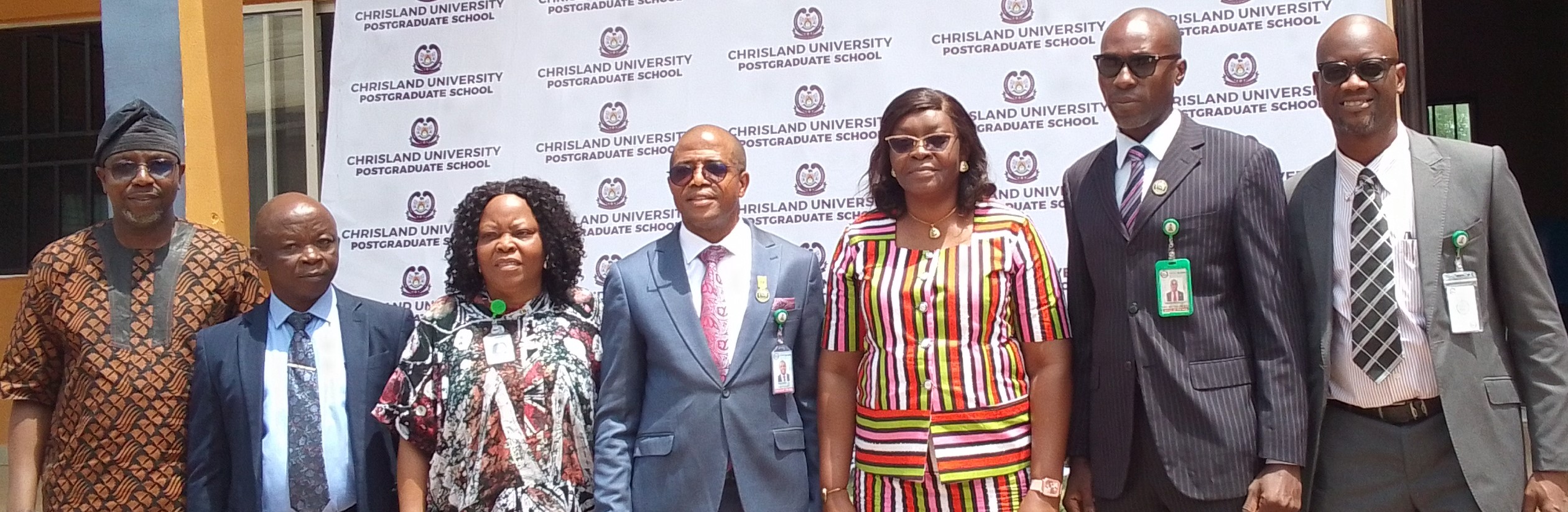
Penpushing reports that Vice-Chancellor of the University, Professor Oyedunni Arulogun, made the call on Thursday at the maiden Postgraduate School Discourse organised by the institution, with the theme, “Consolidating Postgraduate Education in Nigerian Universities.”
The event brought together academics, government officials, postgraduate students and education stakeholders to deliberate on the future of advanced learning and research in Nigeria.
Penpushing further reports that, Arulogun described the discourse as the beginning of a new intellectual tradition aimed at strengthening scholarship, promoting innovation and advancing postgraduate education within the institution and across the country.
The Vice Chancellor added that the programme signifies more than the inauguration of a lecture series, as it represents the beginning of sustained intellectual engagement capable of enriching scholarship and stimulating innovative ideas that will shape the future of higher education.
Penpushing also reports that he said universities across the world are no longer assessed merely by the number of graduates they produce but by the quality, relevance and impact of their research on society.
The university boss noted that postgraduate education remains the engine room of knowledge creation, technological innovation and national development, stressing that the strength of any university’s postgraduate programme reflects its academic maturity and contribution to national growth.
Penpushing reports that Arulogun explained that Chrisland University is committed to building a postgraduate school founded on academic excellence, rigorous research, innovation, interdisciplinary collaboration, ethical scholarship and global relevance.
The Vice Chancellor explained that the university envisions a postgraduate ecosystem where curiosity is encouraged, creativity is nurtured and research outcomes contribute meaningfully to industry, healthcare, education, entrepreneurship, public policy and sustainable development.
Penpushing further reports that she urged postgraduate students to see their programmes as more than an avenue for acquiring additional qualifications, describing advanced education as a lifelong commitment to disciplined inquiry, resilience, originality, intellectual curiosity and the pursuit of practical solutions to societal challenges.
The Vice Chancellor commended the university’s Postgraduate School for initiating the discourse and expressed optimism that it would become a regular intellectual platform bringing together distinguished scholars, policymakers, industry leaders and researchers to shape the future of postgraduate education in Nigeria and beyond.
Penpushing also reports that, Ogun State Head of Service, Olanrewaju Saka in his goodwill message applauded Chrisland University for creating a platform that promotes scholarly engagement and meaningful dialogue on issues affecting higher education.
The number one civil servant in the state described the lecture theme as timely, noting that postgraduate education occupies a strategic position in promoting research, innovation and sustainable national development.
Penpushing reports that he congratulated the university management, for its commitment to academic excellence and human capital development, adding that such initiatives would strengthen educational institutions and prepare future leaders capable of responding to emerging global challenges.
The Head of Service said the administration of Governor Dapo Abiodun remains committed to investing in education, research, innovation and capacity development under its ISEYA agenda, while maintaining productive partnerships with institutions of higher learning to drive socio-economic transformation.
Penpushing further reports that he stated that robust postgraduate education and quality research remain indispensable tools for policy innovation, evidence-based governance and sustainable development/
The Head of Service expressed hope that the discourse would generate practical recommendations capable of improving research output and strengthening postgraduate education nationwide.
Penpushing also reports that, the keynote lecture was delivered by Professor Abel Idowu Olayinka, who identified inadequate funding, poor infrastructure, shortage of qualified academic supervisors and brain drain as major obstacles confronting postgraduate education in Nigeria.
The Professor of Applied Geophysics and former Vice-Chancellor of the University of Ibadan, disclosed that only about 15 per cent of Nigerian undergraduates proceed to postgraduate studies due to high costs, limited admission opportunities and frequent disruptions of academic calendars caused by industrial actions.
Penpushing reports that he equally observed that many postgraduate programmes still suffer from inadequate laboratories, poor library facilities and insufficient numbers of qualified supervisors, warning that such deficiencies continue to affect the quality of research and postgraduate training.
The keynote speaker pointed out that, although the Tertiary Education Trust Fund (TETFund) has continued to support postgraduate research, funding from industries but remains grossly inadequate, while nearly 60 per cent of Nigerian PhD holders reside abroad because of poor remuneration and limited research opportunities at home.
Penpushing further reports that he stressed that if Nigeria hopes to realise its Vision 2050 and the Sustainable Development Goals, greater emphasis must be placed on postgraduate enrolment, particularly in science, technology, engineering, mathematics, agriculture, healthcare and public policy.
The former Vice Chancellor explained that postgraduate education has the potential to transform Nigeria’s growing population from a demographic burden into a demographic dividend by producing highly skilled researchers capable of solving national challenges.
Penpushing also reports that he emphasised that postgraduate research should focus on strategic national priorities such as food security, renewable energy, climate change adaptation, biodiversity conservation, healthcare delivery, disease control, artificial intelligence, biotechnology, nanotechnology, infrastructure development, conflict resolution, governance reforms, justice administration, indigenous knowledge systems and smart city development.
The keynote speaker noted that postgraduate education extends beyond the award of higher degrees, stressing that it must produce innovations, policies and technologies capable of improving the nation’s economy and the quality of life of its citizens.
Penpushing reports that he, however, commended Chrisland University’s Postgraduate School for laying a solid foundation through capacity-building workshops and the inauguration of the discourse series, expressing confidence that the institution would continue to record significant academic achievements.
The guest lecturer speaking with journalists after the lecture, reiterated that inadequate funding remains the greatest challenge facing postgraduate education in Nigeria, explaining that many prospective Master’s and PhD students struggle to finance their education.
Penpushing further reports that he pointed out that universities lack sufficient lecturers, modern laboratories, stable electricity, water supply and other essential research facilities required for quality postgraduate training.
The keynote speaker urged government at all levels to establish scholarship and bursary schemes for postgraduate students, arguing that increased investment would enable more Nigerians to complete advanced degrees and subsequently expand the country’s pool of qualified researchers and academic supervisors.
Penpushing also reports that he stressed the need to strengthen university departments by recruiting more lecturers and improving research infrastructure, noting that although Nigeria has over 300 universities, many still lack the facilities required to produce globally competitive postgraduate graduates.
The guest lecturer maintained that Nigerian students possess the intellectual capacity to compete globally but require an enabling environment supported by adequate funding, reliable electricity, modern equipment and sustained investment in research to maximise their potential.
Penpushing reports that he called on governments, universities, industries and development partners to collaborate in strengthening postgraduate education as a critical instrument for innovation, knowledge production and sustainable national development.
FOOTNOTE: You want to share story with us? You want to advertise with us? You need publicity for product, or service, or event? Contact us on WhatsApp +2348073463653 or email penpushing@yahoo.com